
Hemp is a popular plant known for its versatility. Since its discovery, it has helped in the making of paper, ropes, and even in construction. According to various believes, hemp was used to build the pyramids that we see today. This shows the durability of the hemp plant since it has the flexibility and strength to survive harsh weather conditions for centuries.
Our ancestors already knew about the benefits of hemp for construction and the modern construction industry has easily adopted this wonderful construction material. Hemp has high material strength which makes it able to withstand extreme conditions. This makes it suitable for most engineers and construction workers. This article focuses on Hempcrete, a bio-composite of hemp and lime, which has taken the world by storm.
What is Hempcrete?
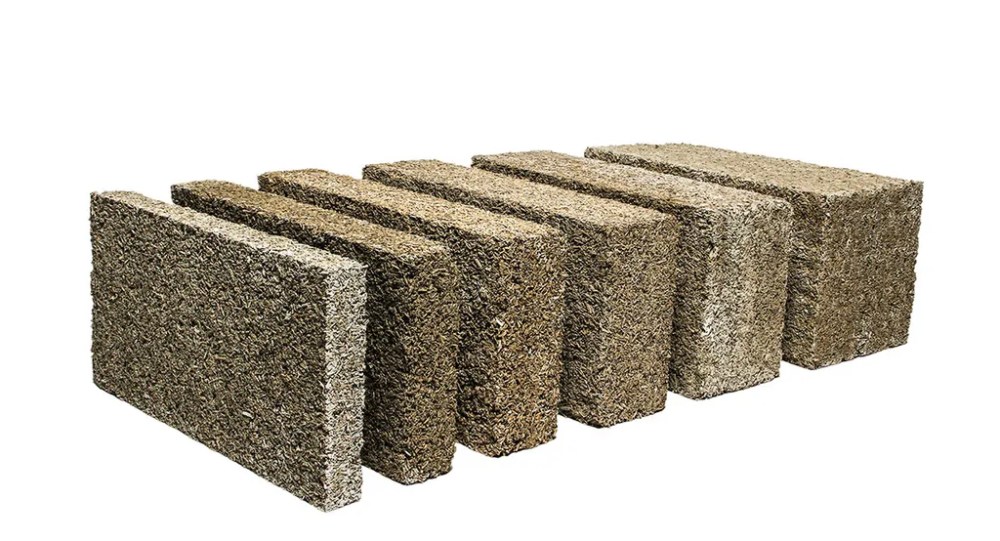
Hempcrete is a superior building material that results from combining hemp hurd or shiv and a mineral binder (lime) as well as suitable quantities of water. The lime acts as a binder that coats the hemp particles and its reaction with the water help the lime to glue the hemp particles together to provide a material with high strength. Leftover moisture is then removed from the blend.
Combining the lime binder and the water sparks a chemical reaction, which results in the binder stabilizing and gluing the hurd particles together. This process is also known as “bonded cellulose insulation.” And its results in a residue called Hempcrete.
The main difference between Hempcrete and conventional construction composites is that the binder in Hempcrete has a lot of void space between the hemp particles; it simply coats the particles and attracts each particle together for a stronger consistency. When you look at the final mixture, Hempcrete does not fill all the voids. And this ensures that the material becomes breathable and lightweight.
By experimenting on the composition, you can produce hempcrete with different structural, thermal, and moisture-absorbent characteristics. Each type of hempcrete can be used for the construction of different structural components and insulation.
Why hempcrete is better than concrete?
Modern-day building materials usually come from mined earth minerals or wood from the forest. Hemp grows year-round and can be harvested in perpetuity. An acre of hemp can produce 4.1 acres of trees. Since trees usually need decades to grow while hemp takes about 4 months, we can clearly see the advantages. In some US states, you can even grow several hemp crops a year.

Advantages of hempcrete
Originates from a natural source
Hemp results entirely from organic materials and lacks the addition of any synthetic components. Therefore, the Hempcrete which results from hemp is natural and can easily be cultivated year-round. This makes it good for the soil as it prevents erosion.
Hempcrete lacks the large carbon footprint offered by traditional construction material which is detrimental for the planet.
Low Maintenance
Hempcrete has most of the properties of the hemp plant and this easily shows in its low maintenance. Hempcrete needs little or no care. Even after usage, the insulation stays for longer and effectively safeguards the built structure from the elements.
Structurally durable
Hempcrete is a considerably dense material when compared to conventional insulating substances. Its durability ensures the structural capacity of the constructional framework. Furthermore, hempcrete also offers a great surface area for plaster finishes.
Highly absorbent to carbon
The Hemp plant is widely known for its high carbon absorbent properties, which are also found in Hempcrete. Hempcrete withdraws about 100 kilograms of carbon per cubic meter of the material. This is very important in the fight against global warming as conventional construction materials emit carbon into the atmosphere during their manufacturing processes.
Excellently handles moisture
The porous nature of hempcrete enables it to store large amounts of moisture without damaging the structural integrity of the building.
Hemp fiber has a large internal surface area which facilitates the storage of high amounts of moisture which can later be released into the atmosphere during favorable conditions.
Resistant to common hazards
One of the main advantages of Hempcrete is its high resistance to common issues faced by building materials. Hempcrete is can’t be influenced by flames, this means that hempcrete buildings are automatically fire-proof.
Also, the lime binder in hempcrete makes it highly resistant to fungus, and also has anti-microbial properties. This lends that Hempcrete is highly resistant to the formation of mold even under very humid conditions.
Insulation Properties
The antifungal, antimicrobial and moisture-absorbent properties of Hempcrete make it great for insulation in both hot and cold climates. Its ability to adapt to moisture makes it good for usage in very humid climates where normal insulation materials aren’t capable.
Further, Hempcrete is very soundproof, making it suitable for shielding out external noise.
Lightweight
The lightweight nature of hempcrete provides ease and efficiency to the construction process. Builders can move it to higher heights without getting injured. Its lightweight nature also makes it suitable for constructing story buildings, roofs, and lofts.
Non-toxic and recyclable
Hempcrete is free of toxic properties. This means it won’t release any harmful substances into the building structure that can be harmful to kids or even the inhabitants of the building. Also, the biodegradable nature of hemp makes it completely recyclable and reusable without any harm.
What Can Be Made with Hempcrete?
Hemp can fit into any aspect, so rather ask what can’t be made with hemp. Hempcrete is useful in several construction projects including homes, apartments, skyscrapers, and departmental stores. Hemp has endless possibilities. Hempcrete is a natural fire-resister, moisture-resister, and pest resister and all these properties place it among the best construction materials in the world.
Bottom line
Despite the endless advantages offered by hempcrete, it is not perfect. One drawback to hempcrete is that it usually requires longer periods to cure, so it’s not recommended for load-bearing walls. However, companies have started making hempcrete bricks to make up for this issue. It’s still at an early stage as only a few companies make hempcrete bricks. They are manufactured in a way that reduces the time required to cure.
Discover more from TokeN Timber
Subscribe to get the latest posts sent to your email.

